
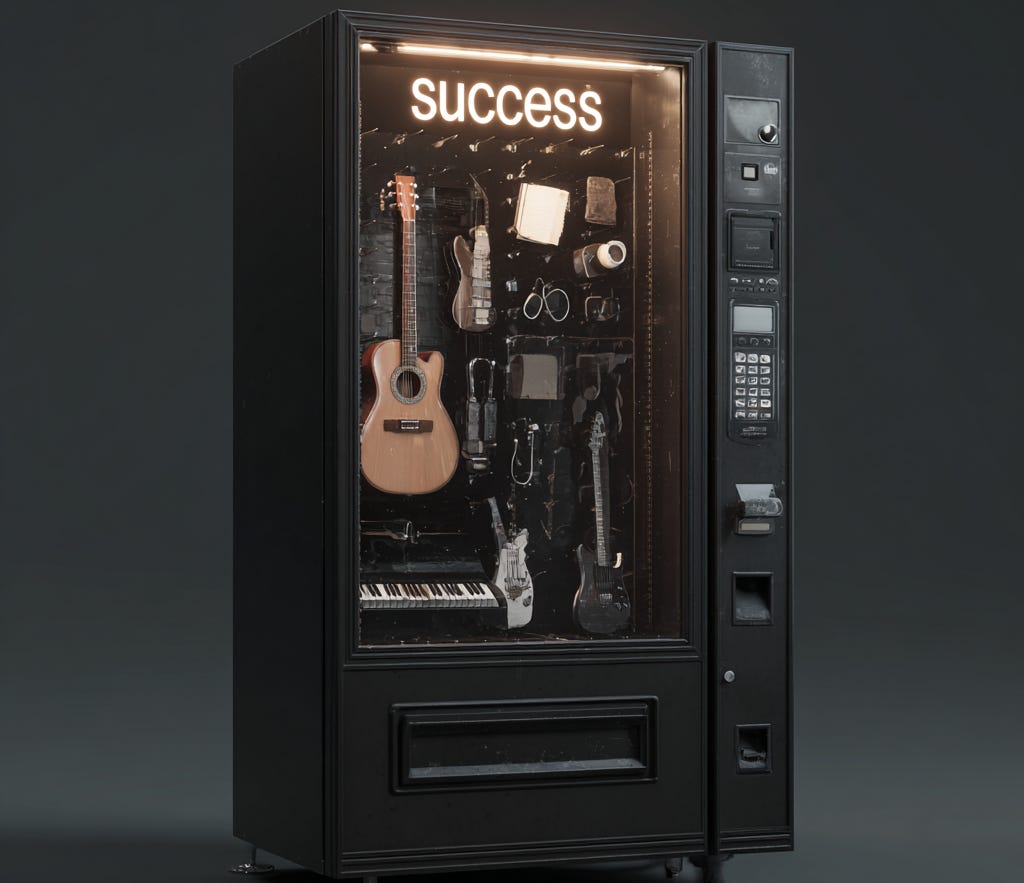
There was a time when effort and reward moved together, intertwined. You put in-you get out. You could climb a hill and be paid back with the view from the top (metaphorically, we can still do this!!).
A solved problem came with an internal sense that you had earned it. That relationship, between process and outcome has shaped not just economies and careers, but our identities and given our lives meaning.
Now imagine those experiences collapsing into a single beat, a brief moment. What happens then?
With the rise of artificial intelligence, we’re stepping into a world where results can appear almost instantly. What once took days, months, even years, can now be generated in seconds. The friction is gone. The waiting is gone. Increasingly, the process itself is all but optional.
At first, it does feel like progress. I mean, of course it does—getting more done with less effort has always been the goal. We all strive/hope to be more efficient, but the more I think about it, the more something feels slightly off. If things come too easily, they don’t seem to last in the same way. You don’t remember, value, or even feel that satisfied by them. And I can’t tell if that’s just nostalgia talking, or if there’s actually something important in the effort.
So, when outcomes are detached from effort, what happens to the meaning we assign to them?
There’s an old phrase—“easy come, easy go.” It’s usually said nonchalantly with a shrug, but it hints at something deeper. We instinctively value what costs us something. Time, energy, attention, struggle—these aren’t just obstacles; they’re part of the magic that transforms an outcome into something meaningful. Remove them and you risk removing the emotional depth from our lives.
This is more than just philosophical though, it’s biological.
Human motivation is tightly bound to dopamine, the brain’s reward chemical. It’s often misunderstood as the “pleasure molecule,” but it’s more accurate to think of it as the driver of anticipation and effort. Dopamine spikes not just when we achieve something, but when we work towards it. The journey matters because the brain is wired to make it matter.
When rewards become instant and ubiquitous, does this system break down? If everything is easy, nothing feels particularly valuable. Not because the rewards themselves are diminished, but because the pathway to them no longer demands engagement. Over time, this can dull motivation, making longer, more demanding pursuits feel disproportionately difficult or even pointless.
Instead of investing in deep, time-consuming work, we gravitate toward what delivers quick hits of stimulation. Why spend years learning to play an instrument when a machine can generate something polished in seconds? Why wrestle with a blank page when completion is always one prompt away?
It all sounds efficient. It even sounds exciting. But with that, uncomfortable questions emerge: if the reward is no longer tied to the process, why would we bother engaging in the process at all?
This isn’t an abstract concern. It becomes personal very quickly. Imagine spending years developing your craft—music, writing, art, only to watch AI-generated alternatives outperform you in speed, reach, and even reception. The comparison seems unfair, and occasionally it’s existential. How long do you keep going when effort itself seems devalued?
I think about this so much, asking myself almost daily, how can I compete? Do I still want to? And yet I’ve been doing it so long it’s hard-wired into me. GOOD WORK TAKES TIME. Things that have depth and meaning can’t be created out of thing air. Can they? You may have noticed there’s lots of questions in this post. Here’s more.
So what is reward in these situations? Does it need redefining? There’s no easy answer, especially when even to me, someone who’s spent a life creating, I can see why it’d be so tempting, desired or ultimately preferred.
If outcomes are cheapened by abundance, then perhaps value shifts back toward experience. The act of creating, learning, struggling—these might become ends in themselves rather than means to an end. Not because they’re efficient, but precisely because they’re not. In a world of instant results, the process could become a rare commodity or what we again in time, see as the important part. I’m trying to stay positive in believing that this will be highly valued once again.
Another possibility of course is less optimistic. We may drift further into cycles of passive consumption, chasing smaller and more frequent dopamine hits while avoiding the discomfort of sustained effort. Over time, that could erode not just how we feel, and in turn our productivity, but a deeper sense of purpose.
The truth is, as with so many aspects of our current situation, we’re transitioning into a world with too many unknowns. Yes, that can be scary, but it’s also totally fascinating!
The old model, input equals output, effort equals reward—is being rewritten in real time. Whether that leads to liberation or disorientation, utopia or dystopia, may depend less on the technology itself and more on how we choose to relate to it.
Because even if the world no longer requires us to struggle for results, something in us still might.
So, what do you think?
P.S. For the sake of clarity (though it’s blindingly obvious given the keyboard above has four black notes in a row), the images at the top are AI. I spend all my time making music to test the theory that “real music is still better than AI”. I spend time writing down thoughts as they come into my head that will one day become an article. I spend time in the real world with my kids and cook food that has not come from a vending machine, so please allow me to take one short cut and not see me as a hypocrite. I BEG YOU!! Thanks.
[Hi from about 26 years ago!] A friend of mine, who usually produces music using retro hardware (x0x boxes, Junos etc) did an experiment whereby he made an entire glitchy electronica album, including the track names and artwork, using AI. His online fans were appalled. That was part of the experiment.
It did actually sound quite good. He used a thing called Udio. As my own home studio mostly collects dust it certainly added weight to my whole “why even bother any more?” existential crisis.
But, to paraphrase what you said, the friction is the fun of it. Music in particular has been devalued for a long time because obviously making it has become so much more accessible, so it’s more diluted. But enthusiasts still do plenty of things they don’t need to do just for the pleasure of it, such as maintaining and driving steam engines. Cottage industries exist.
So there’s nothing stopping us putting on our own ’hardware only’ events (for example) if we so wish and it’s still fun to run synths through crackly old guitar pedals and such even though if there are plugins that do that for you, or you can just tell your AI generator to make it sound dirtier (kind of an extension of the same thing?)
Arguably much of Brian Eno’s music is generative and his role became that of the curator / selector: Let the machine run then keep the best bits. I could code my own generative thing in Max4Live but the parameters are still of my design. But I really feel that prompt-based creative is different on a fundamental level, and actually just not interesting any more.
I personally will never see the point of using a prompt to create a piece of music, nor do I want to listen to something that someone’s frontal lobes haven’t pored over the details of. That said I did feel a deep disturbance at how good my friend’s glitch album sounded.